Delivered by people, backed by data
A briefing for policymakers ahead of the 2026 Scottish Parliament Election
The Wise Group’s vision
Sean Duffy, Chief Executive
Poverty isn’t just about money — it’s about life chances.
Today, people face connected problems but meet disconnected services. On paper, support looks comprehensive; in real life, it’s duplicative, exhausting, and too often misses the mark. Without tackling the structural barriers that prevent people from thriving — poor mental health, fuel poverty, housing insecurity, digital exclusion, low confidence — we are managing poverty, not preventing it, far less reversing it.
Households living in poverty are crowded with well-intentioned interventions — welfare assessments, housing appointments, health referrals, employability programmes — all designed in isolation.
On paper, the support looks comprehensive. On paper, it looks like progress. In reality, it’s disconnected, duplicative, and exhausting. For the person navigating it, it’s just noise.
Our data shows the pattern clearly: when someone presents with an Energy need, 86% also have Financial Instability, 75% have mental ill health, and 73% require support with housing and basic needs. Almost half of them suffer low confidence and self-esteem. They are also 1.5x more likely to have a physical health need than someone without an energy need.
Poverty clusters; services shouldn’t. We must fix systems and back people.
That’s what the Wise Group does. We use data to find those least well-served, then pair them with Relational Mentors who stay long enough (typically six months) to embed change across the 15 life areas that drive risk. It’s practical, human, and proven. Delivered by people, backed by data.
This isn’t a quick fix; it’s prevention as infrastructure - one household at a time, aligned to local systems, delivering public value that lasts. Reversing poverty costs less than managing it. Prevention pays -
morally, socially, and fiscally.
The people we need to support are those systemically overlooked. They’re not on the poverty line; they can’t even see the poverty line. They’re on the darkest part of the poverty spectrum.
The poverty they experience is expensive. Economically expensive. Socially expensive. Morally expensive.
At the Wise Group we work at the intersection of lived experience, system design and data. We have the data to understand who those overlooked are, and we have the people to help them. Delivered by people, backed by data - that’s what we do at the Wise Group.
We give people a chance, one household at a time. Our Mentors act as connectors, enabling households to work with the system and access the right support at the right time.
And they take their time. Quick fixes don’t work, and change has to be embedded before we can expect it to last. Reversing poverty costs less than managing it. Preventing poverty costs less than managing it.
Our model is proven and scalable, and can deliver long-term public value. Wise Group is reversing poverty; not managing it.
Summary of our policy recommendations
Our vision for reversing and preventing poverty is based on our position at the intersection between people, data and systems. It is underpinned by four themes, which we think are worthy of consideration for political party manifestos ahead of the May 2026 Scottish Parliament election:
1. Finding and reversing poverty
A. Adopt a national “Find & Invite” model:
Ethically use multi-source data (including energy debt early-warning) to proactively identify and invite least well-served households into support.
b. Fund place-based integration layers:
Commission an “integration function” (not just services) so people encounter one coordinated pathway, not silos.
c. Set compound outcome metrics:
Measure and pay for bundles of outcomes (income, housing stability, health, school attendance), not single-issue activity.
2. Intervening to prevent poverty
a. Back a Whole-Family Pathway into good work:
Align employability, childcare, and mental health with unconditional Mentoring through key transitions.(AberWise)
b. Create Prevention Funding Windows:
Allow commissioners to invest ahead of crisis and recycle savings (outcomes-based).
c. Mandate data-sharing by design:
Local protocols that let trusted partners act early, safely, and lawfully
3. Mentoring at-risk individuals
a. Scale Relational Mentoring Scotland:
A national programme with local delivery, typical engagement (approx six months), caseloads that protect quality.
b. Pay for persistence:
Incentivise engagement/retention with those furthest from help; don’t just reward easy wins.
c. Accredit and professionalise the workforce:
Standard, trauma-informed practice with lived-experience routes and progression??? (need to consider against our ambition to create a relational Mentoring Academy
4. Making net zero work on the ground
a. Warm homes as prevention:
Track energy affordability, health, and school attendance as core outcomes.
b. Protect prepayment customers
and embed debt-first triage with automatic checks for wider needs.
c. Community retrofit aligned to jobs and inclusion
Tie retrofit to local skills pipelines and targeted Mentoring; support digitally excluded households to benefit.
Our data - the key to finding poverty
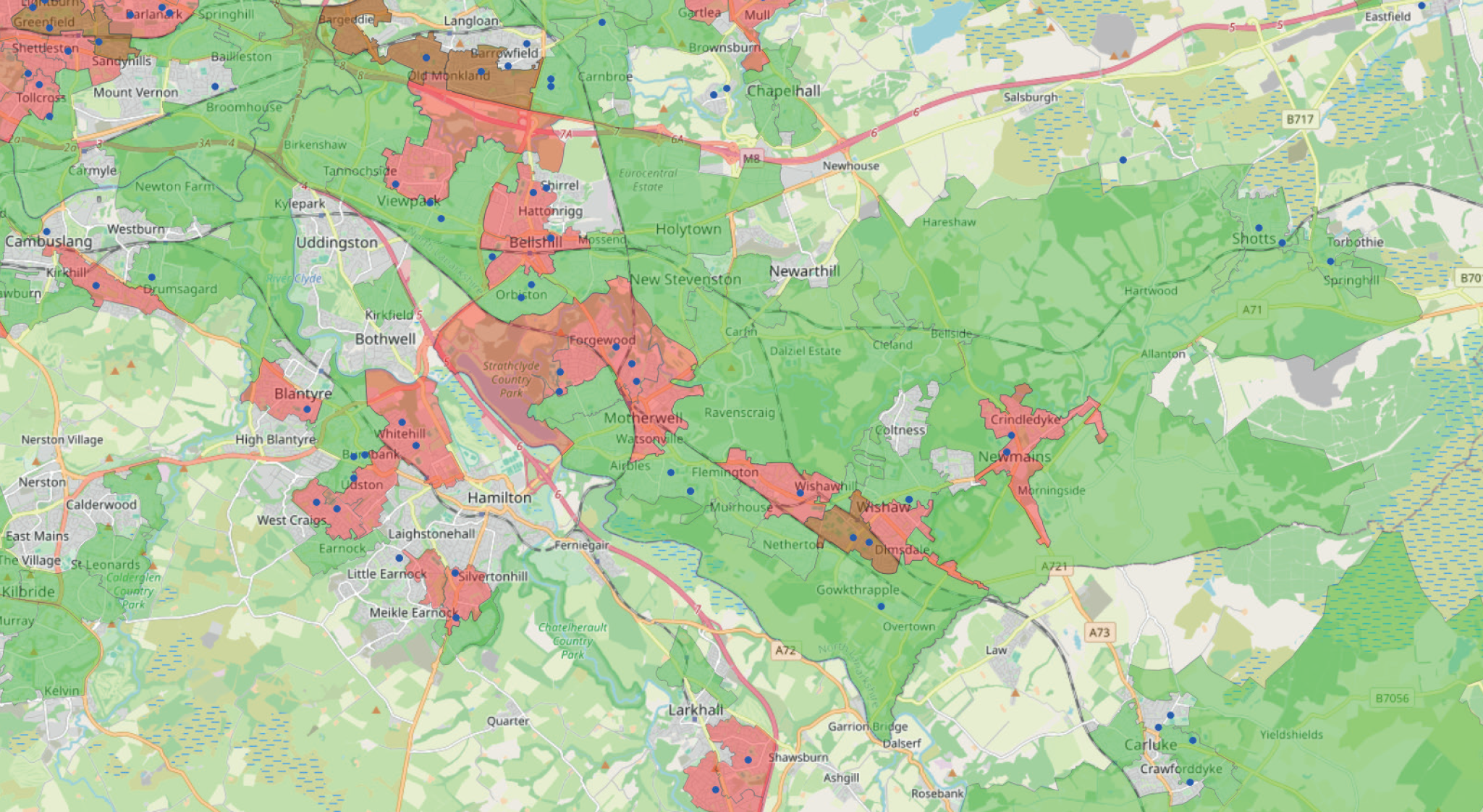
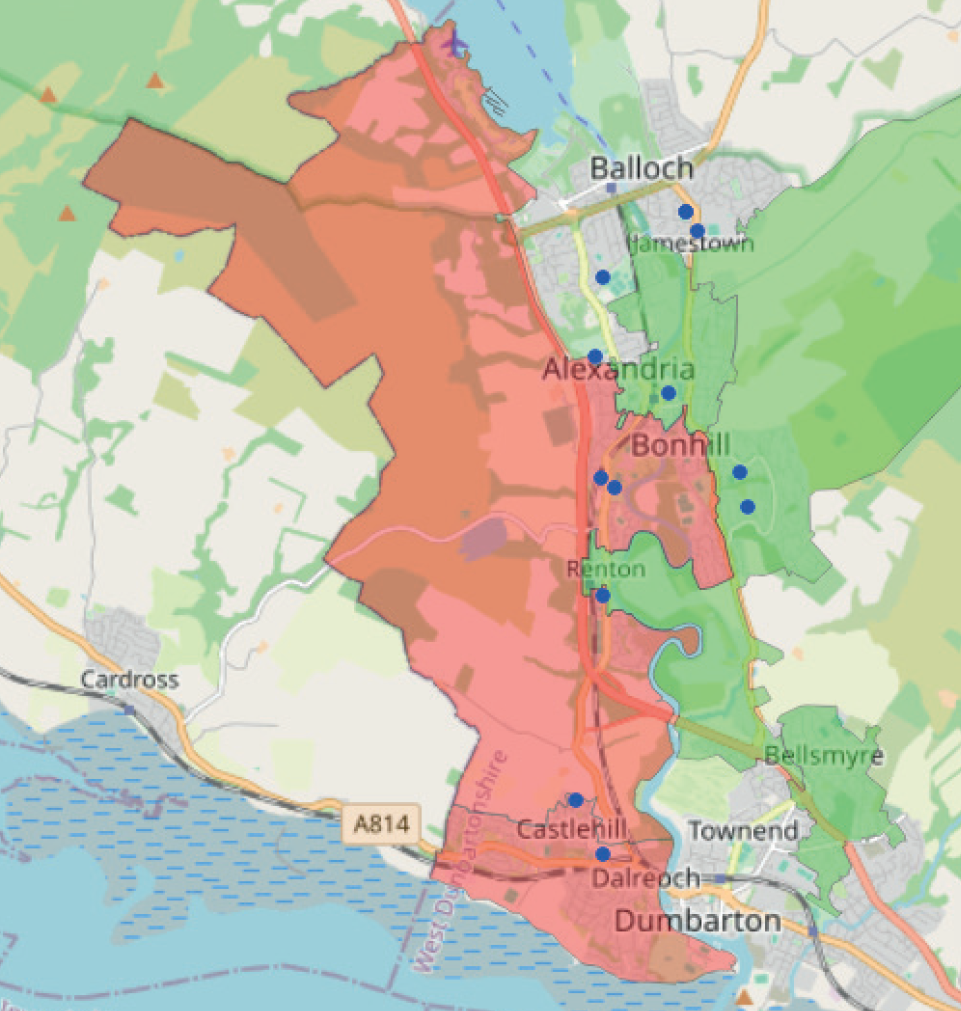
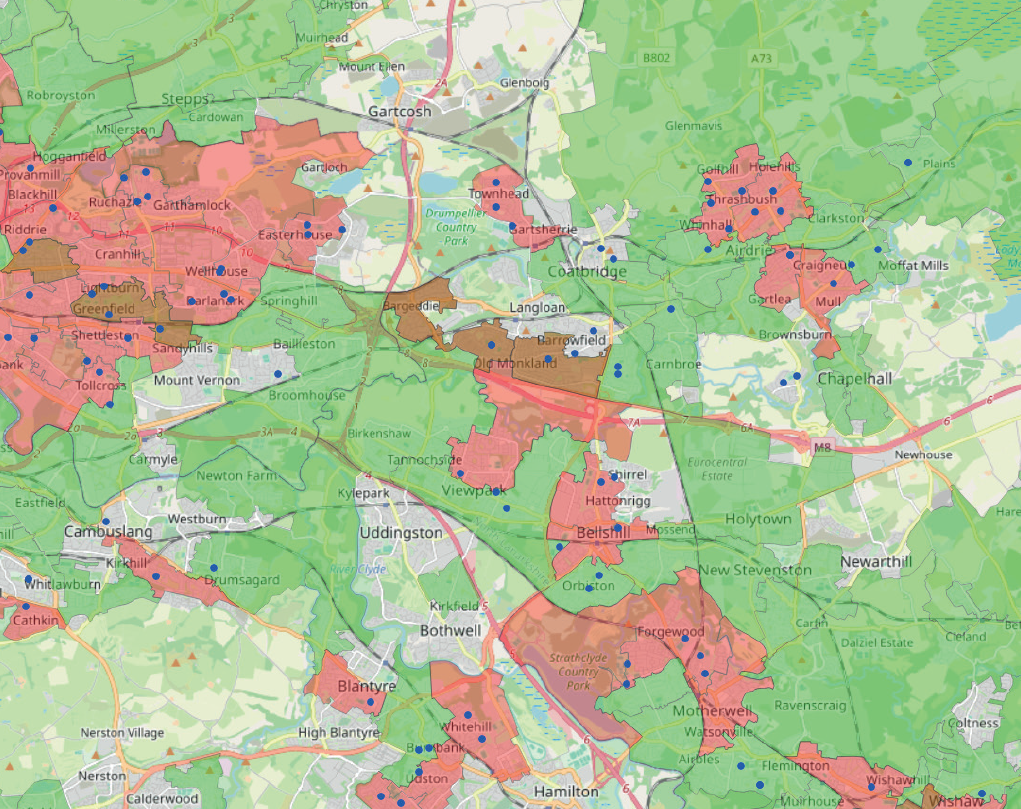
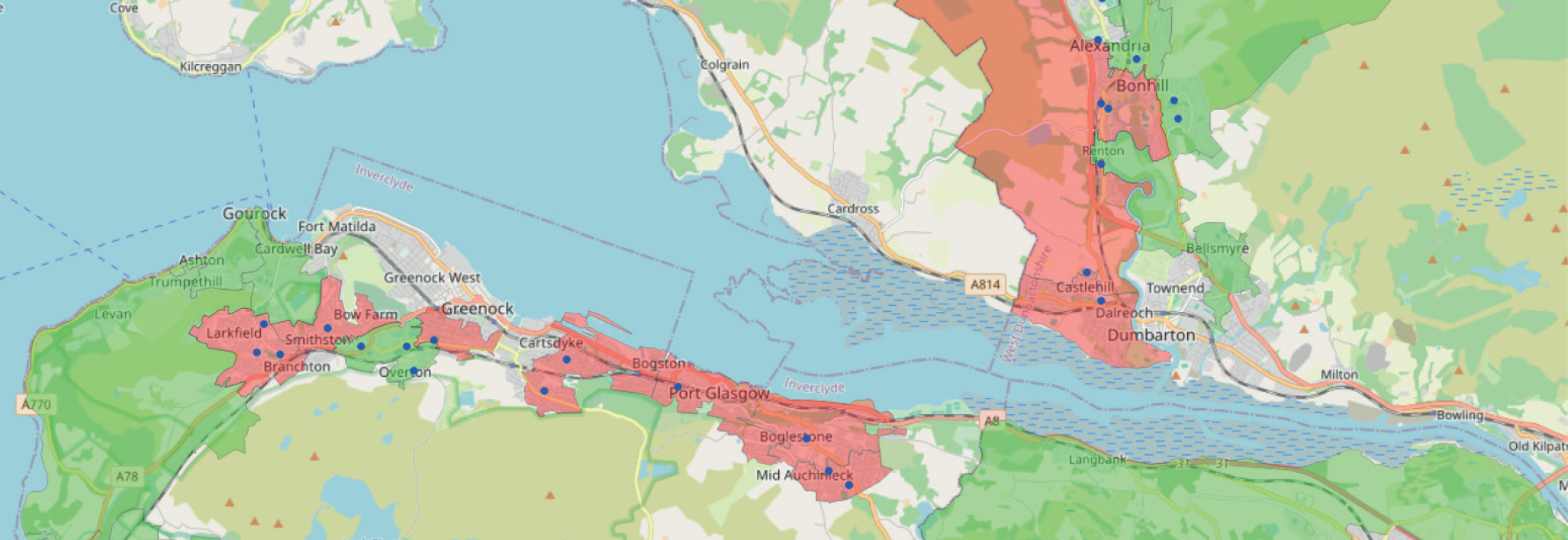
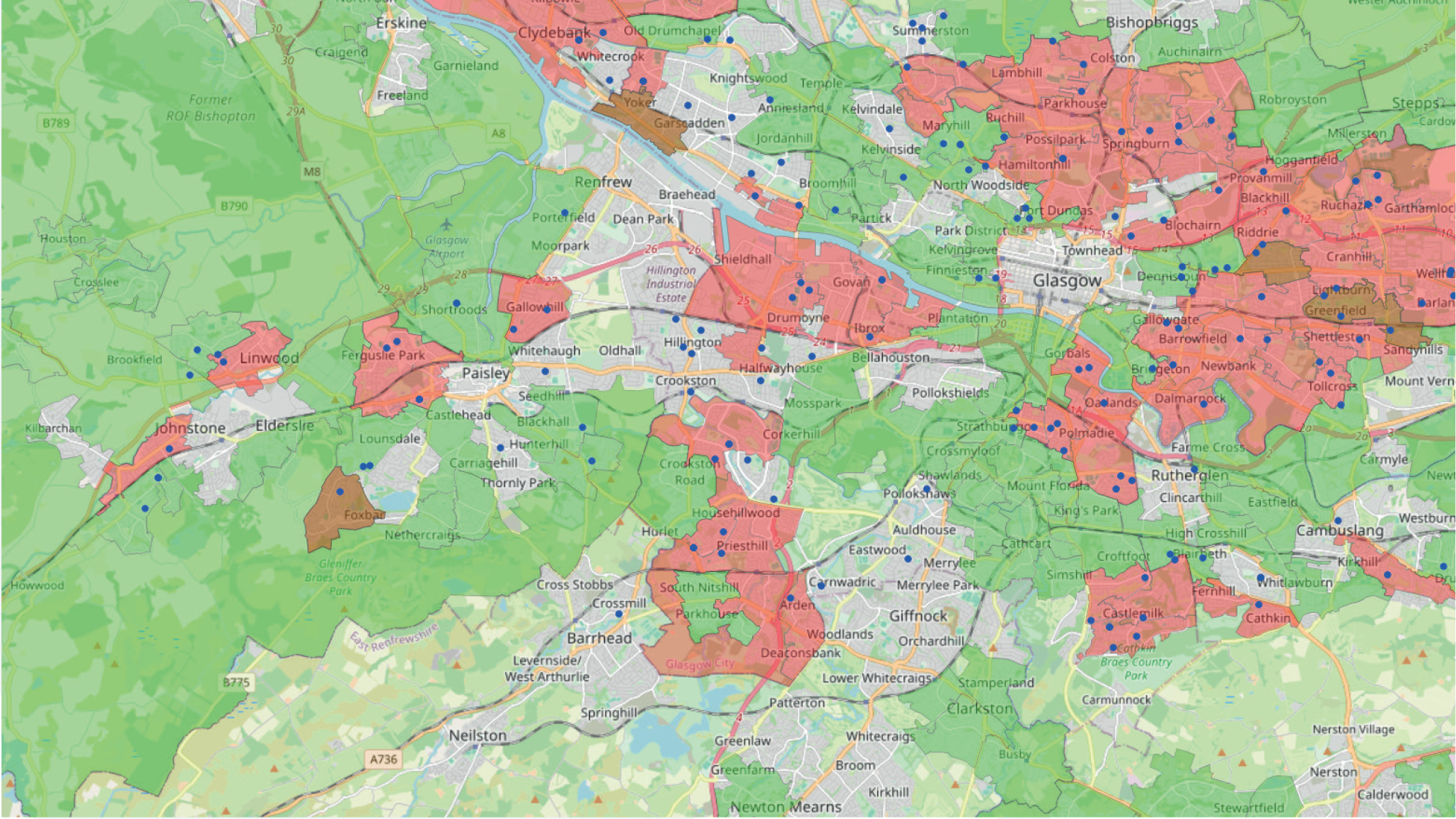
By pulling together data from multiple sources, including our own data, we map communities in greatest need - allowing us to target our support where it’s most needed.
Data sources we use:
Relational mentoring - the key to preventing poverty
Our Relational Mentoring model, with support from the Scottish Government, currently supports families in six local authorities - Glasgow, North and South Lanarkshire, Renfrewshire, Inverclyde and the Scottish Borders. It is built around 15 interconnected areas of need, including employment, income, mental health, childcare, fuel poverty and more. A key differentiator of our model is our focus on progression rather than a static goal. We track the progress individuals make, not simply the completion of a training course or claiming an outcome. This approach provides a more nuanced and accurate picture of the impact we have, highlighting the transformative journey of each household.
What are we doing?
What makes Relational Mentoring different?
Relational Mentors are not advisers, caseworkers or navigators. They do three things the system does not currently do well:
1. They hold the whole picture
Mentors work across 15 life areas simultaneously, recognising that progress in one domain (e.g. work) is impossible without stability in others (e.g. energy, housing, mental health).
2. They stay long enough for change to stick
Typical engagement lasts around six months - long enough to embed new behaviours, rebuild confidence, and ensure services actually join up.
3. They are accountable for progression, not transactions
Success is measured by sustained movement away from crisis, not attendance, referrals, or short-term outputs.

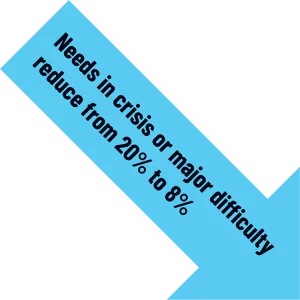
Overall stability improves (score shifts from 3.7 to –4.2), reducing future demand on crisis services.
Progression is sustained, but there’s no quick fixes
A fully random survey was carried out with households 6+ months after leaving the service. 143 people were contacted. The standard Needs Assessment was repeated.
Finding and reversing poverty
Tackling poverty is quick and easy in theory, but slow and difficult in practice.
Tackling poverty is simple in theory, hard in practice. Income support matters - urgently - but on its own it rarely sustains change for those well below typical thresholds. Money without integration manages crisis; it doesn’t reverse it.
1
Find the least well-served using ethical, local data
2
Understand the full picture across 15 life areas (most households show eight needs)
3
Embed change with a mentor over approximately six months so new habits stick and services join up
This is how reversal becomes prevention. Fix systems and back people - and the change lasts.
In theory, money is the answer. We work with people who will not have heating tomorrow without money today, and who cannot put breakfast on the table tomorrow without money today. So, the importance of cash benefits like the Scottish Child Payment or Winter Heating Benefit should not be understated.
But it should also not be overstated. We have a habit of looking at the payment of benefits as ‘job done’. The truth is far from that. Cash benefits may help tomorrow, but for those we support, living in deep poverty, they don’t help the day after that. They do not lift people out of poverty in the longer term.
In practice, that requires far more than money. Indeed, more money will inevitably have diminishing returns. More money manages poverty, but it does not reverse it.
Instead, firstly, we need to reach the hardest to reach. That needs data - and we have it. Our data tool, annually records over one million data points through its bespoke CRM system, Remy. This data forms the backbone of our work, allowing us to track progress, compare customer cohorts, and demonstrate the realworld impact of our efforts. It provides us with granular data of those who are hardest to find, telling us who they are and where they are. That’s job one - we can’t help people until we find them.
The second job is to understand them. Our Mentors look at 15 different indicators which link to poverty; our average household presents with eight, and around one third need support in ten or more areas.
If Scotland is serious about prevention, Relational Mentoring must move from the margins to the mainstream. That means commissioning for persistence, funding integration rather than activity, and measuring success by sustained stability - not short-term throughout.
This coaching (we call it Relational Mentoring) builds confidence and capability, unlocking participation and reducing disengagement. One person at a time, one household at a time, Relational Mentoring is the key to equipping people in the deepest poverty with the tools not only to survive, but to thrive. It requires investment on an individual rather than a universal basis, but it is investment which confers clear returns in the form of improved health, increased economic activity and long-term public value.

Reversing poverty and preventing poverty are two sides of the same coin. Prevention isn’t a programme; it’s infrastructure. Our Mentors add capacity to stretched services and coherence to fragmented journeys: sorting energy debt, securing entitlements, stabilising housing, reconnecting with health, school and work, and building digital confidence.When adults stabilise, children’s risks fall. That’s how reversal today becomes prevention tomorrow — breaking intergenerational poverty by design, not luck.
Our data finds poverty, and our Mentors reverse it by adding capacity and value to existing services. Our Mentors are not volunteers; they are professionals trained to find all the indicators of poverty a person is experiencing, and helping to fix them one by one.
In practice, that means helping people structure and repay energy debt, helping people to access digital banking, helping people to navigate assistance from the welfare system, helping their interaction with the NHS, schools and housing services, and of course helping people into work.
The compound impact of our Mentoring is a poverty reversal process. However it morphs into a poverty prevention process, because reversal amongst adults is also prevention for their children.
Child poverty is, almost always, intergenerational poverty, so tackling intergenerational poverty and tackling child poverty is part of the same process.
Breaking intergenerational poverty and preventing child poverty should be a national mission above all others. However we talk a much better game than we play. Our systems don’t break intergenerational poverty; they entrench it.
Mentoring at-risk individuals
If we’re serious about outcomes (not optics), we must pay for persistence with those whoneed it most and measure compound gains, not single-issue activity.
At the Wise Group, we find and reverse poverty using our data tool. And we intervene to prevent poverty, breaking the intergenerational links which are so often the source of the child poverty we see today.
All of this - our ability to find poverty, reverse poverty, prevent poverty and break intergenerational poverty - is entirely dependent on our Mentors.
Our Mentors are embedded in the lives of some of the poorest people in this country, for many months at a time, coaching them to live a different life for the rest of their lives. This is a world away from a headline-grabbing universal cash benefit; this is hand-to-hand combat, one household at a time, to offer tools for a better future to the people who need it most.
Enduring change takes time. Our delivery evidence shows that outcomes stabilise when mentoring support is sustained long enough for trust to form, confidence to grow and new behaviours to embed. For most households, this means consistent relational support over several months - not a one-off intervention or short programme that ends just as progress begins.
However, if we as a country are truly in the business of substantive change over superficial continuity, and if we are truly determined to help the hardest to reach as well as the low hanging fruit, then this Relational Mentoring is the proven concept.
Mentoring is the act of turning a large and growing public cost into large and growing public value. The harder to reach, the deeper in poverty and the more multiple the need, then the greater the public benefit of a successful outcome.
In practice, this means a Wise Group Mentor working one-to-one with someone who may have had all the basic pillars of their existence removed by a spell on remand, and whose family will have suffered the knock-on effect of the removal of a parent, the removal of earnings and an immeasurable upheaval of their place in society, with associated physical and mental health consequences.
This is not superficial work. This is a substantive service to people in poverty, and to the country as a whole.
Households are an estimated £1,200 etter off per year on average following our support
Saving the state money:
An estimated state saving of £1,400 on average per household supported, using the UK Social Value Bank figures
Improved quality of life
Equivalent to £11,700 per household supported
Making net zero work on the ground
So measure what matters locally:
Energy affordability
(as % of income)
Financial resilience
(avoiding crisis)
Health
(e.g., cold-related conditions)
Skills & employability progression
School attendance & family stability
And act accordingly:
• Protect prepayment customers and use energy-debt data for early-warning outreach.
• Make community retrofit a jobs and inclusion engine, tied to Mentoring.
• Support digitally excluded households so they benefit from smart tariffs and controls.
Fuel poverty is often regarded as a standalone issue. It is not - it is poverty which is in part composed of fuel debt, but which is in reality caused by a range of other problems including unemployment or underemployment, a skills gap, poor housing and poor physical and mental health.
Because it is not a standalone issue, it cannot be tackled by a standalone solution. This is being tried, and is failing. It can only be improved holistically.
In order to do that, we need to change the approach to fuel poverty targets, basing them on:
Affordability
(energy as a percentage of income)
Financial resilience
(the ability to avoid a crisis)
Health outcomes
(e.g. reducing a cold-related illness)
Employability and skills progression
(as key poverty levers)
School attendance and family stability
(for affected children)
The energy transition to net zero, of course, has a critical role to play here. But it has to mean more than it does today, to those who need it to work the most. Those who can most rapidly benefit from the transition to net zero are seldom those who most need that benefit.
So, to ensure that net zero and poverty reduction work hand in hand, we need to:
• Protect prepayment customers from disadvantage
• Make community-led retrofit schemes part of economic inclusion and job creation
• Support households with a digital deficit to benefit from the energy transition
Mentoring at-risk individuals
If we’re serious about outcomes (not optics), we must pay for persistence with those whoneed it most and measure compound gains, not single-issue activity.
At the Wise Group, we find and reverse poverty using our data tool. And we intervene to prevent poverty, breaking the intergenerational links which are so often the source of the child poverty we see today.
All of this - our ability to find poverty, reverse poverty, prevent poverty and break intergenerational poverty - is entirely dependent on our Mentors.
Our Mentors are embedded in the lives of some of the poorest people in this country, for many months at a time, coaching them to live a different life for the rest of their lives. This is a world away from a headline-grabbing universal cash benefit; this is hand-to-hand combat, one household at a time, to offer tools for a better future to the people who need it most.
Enduring change takes time. Our delivery evidence shows that outcomes stabilise when mentoring support is sustained long enough for trust to form, confidence to grow and new behaviours to embed. For most households, this means consistent relational support over several months - not a one-off intervention or short programme that ends just as progress begins.
However, if we as a country are truly in the business of substantive change over superficial continuity, and if we are truly determined to help the hardest to reach as well as the low hanging fruit, then this Relational Mentoring is the proven concept.
Mentoring is the act of turning a large and growing public cost into large and growing public value. The harder to reach, the deeper in poverty and the more multiple the need, then the greater the public benefit of a successful outcome.
In practice, this means a Wise Group Mentor working one-to-one with someone who may have had all the basic pillars of their existence removed by a spell on remand, and whose family will have suffered the knock-on effect of the removal of a parent, the removal of earnings and an immeasurable upheaval of their place in society, with associated physical and mental health consequences.
This is not superficial work. This is a substantive service to people in poverty, and to the country as a whole.
Households are an estimated £1,200 etter off per year on average following our support
Saving the state money:
An estimated state saving of £1,400 on average per household supported, using the UK Social Value Bank figures
Improved quality of life
Equivalent to £11,700 per household supported

Mental Wellbeing
• 5.5x more likely to have Addictions support need
• 4.5x more likely to have a Building & Maintaining Relationships need
• 3.5x more likely to have a Wellbeing, Self-esteem and Confidence need

Wellbeing, Self-Est. & Conf.
• 5.5x more like to have a Building & Maintaining Relationships need
• 3.5x more likely to have a Social Skills for Work need
• 3.5x more likely to have a Developing Life Skills need

Financial Support
• 2x more likely to have a Building & Maintaining Relationships need, Basic Skills need, Life Skills need, Housing need, and Social Skills need

Addictions
• 8x more likely to have a Building & Maintaining Relationships need
• 1.5x more likely to have a Mental Wellbeing need
• 1.5x more likely to have a Wellbeing, Self-esteem and Confidence need

Basic Skills
• 5x more likely to have Life Skills need
• 3.5x more likely to have a Digital Skills
• 3x more likely to have a Building & Maintaining Relationships need

Energy Assistance
• 1.5x more likely to have a Financial Support need, Physical Health need, and Stability/Housing need

Stability / Housing
• 4.5x more likely to have a Building & Maintaining Relationships need
• 3.5x more likely to have a Developing Life Skills need
• 3.5x more likely to have a Social Skills for Work need

Work Skills & Experience
• 11.5x more likely to have a Social Skills for Work need
• 2x more likely to have a Basic Skills need and Life Skills need
• 1.5x more likely to have a Aspirations & Motivations need