Public services across Scotland work tirelessly to support people facing hardship, yet despite significant effort and investment, many households continue to cycle between services addressing different aspects of the same underlying challenges.
Employment, health, housing stability, energy affordability and financial resilience are rarely separate issues. They interact and reinforce each other.
But the systems designed to respond to them often operate independently, and as a result, support can become fragmented. Households may be referred from one service to another, repeating their circumstances multiple times while navigating complex systems.
The Wise Group’s Reversing Poverty, Not Managing It manifesto begins with a simple observation:
People face connected problems but meet disconnected services. This disconnect can unintentionally sustain demand.
Short interventions can resolve immediate pressures. A benefits issue might be corrected. An energy bill may be addressed. A short employability programme might help someone take a first step back toward work. But when challenges are interconnected, addressing them in isolation rarely changes the wider trajectory.
Managing pressure is not the same as reducing it. Reversing poverty requires systems that respond differently.
Instead of short, disconnected interventions, prevention depends on relational support that persists over time, integrating services around households rather than asking households to navigate systems themselves.
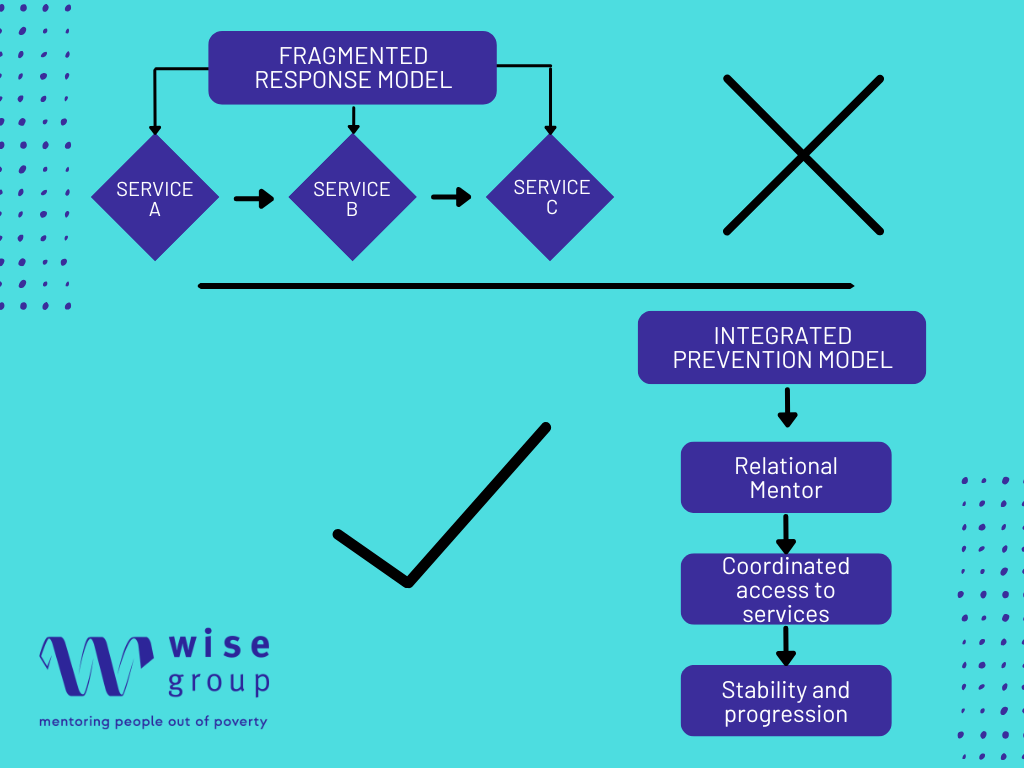
This is exactly the principle behind relational mentoring. Mentors work alongside people across multiple areas of need, helping coordinate services, build confidence and sustain progress over time. The goal is not simply to deliver activity, but to enable lasting change.
Seen in this light, prevention is not another programme layered onto existing services.
It is infrastructure – the connective function that allows support to operate coherently around people’s lives.
The policy question therefore becomes less about whether services exist, and more about how systems are designed. If systems continue to focus on short interventions delivered in isolation, demand will continue to recycle.
If systems invest in integrated support that persists long enough for progress to hold, pressure on crisis services can begin to reduce.
Reversing poverty begins with recognising this difference.