The Wise Group has welcomed the Scottish Government’s commitment to review how progress on child poverty is measured, describing it as an opportunity to broaden the conversation beyond income alone and focus on the conditions that help families build sustainable futures.
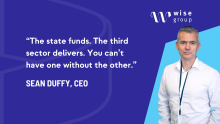
Reflecting on the Cabinet Secretary for Social Justice and Housing’s statement to Parliament, Sean Duffy, Chief Executive of the Wise Group, said that while income and social security remain essential, poverty is rarely experienced as a single issue.
“Families need support today, and Scotland has made choices that have helped keep child poverty below the UK average. But anyone who has spent time alongside families knows that poverty isn’t experienced in neat categories.
“It’s housing, debt, health, childcare, confidence, wellbeing, relationships, employment, stability and opportunity. Most importantly, it’s about how all of those things connect.”
For more than four decades, the Wise Group has worked alongside individuals, families and communities facing multiple and interconnected challenges. Through its Relational Mentoring approach, the enterprise has seen first-hand that progress is rarely linear and that many of the changes that matter most to families are not always visible in headline statistics.
“Sometimes the most significant changes don’t immediately appear in a data set,” Sean continued.
“A parent gaining confidence. A family finding stability. Someone taking positive steps towards employment. Relationships improving. A sense of hope returning. These things matter.”
The Scottish Government’s intention to review the targets contained within the Child Poverty (Scotland) Act 2017 represents an opportunity to consider how success is measured and how policies and services work together to support families.
“The challenge for the years ahead isn’t simply how we respond in moments of crisis, important though that remains. It is how we create the conditions for families to build lasting stability, resilience and opportunity.
“That means prevention as well as protection. It means services working together around people rather than expecting people to navigate fragmented systems. And it means recognising that lasting change is often built through relationships and trust as much as through programmes and policies.”
The Wise Group believes Scotland has made real progress in tackling child poverty, but that further progress will depend on understanding not just whether poverty is reducing, but why.
“One lesson continues to stand out above all others,” said Sean.
“People don’t live in policy silos, and it is important that we don’t work in them either.
“There is more to do, and we need to keep learning, adapting and moving forward. Yesterday’s statement felt like another welcome step towards a broader conversation about what success really looks like, how we deliver it and how we measure it.
“Importantly, it suggests a willingness to look beyond individual interventions and towards the wider conditions that help families build sustainable futures.
“That’s a conversation worth having.”